Driver Lap Times
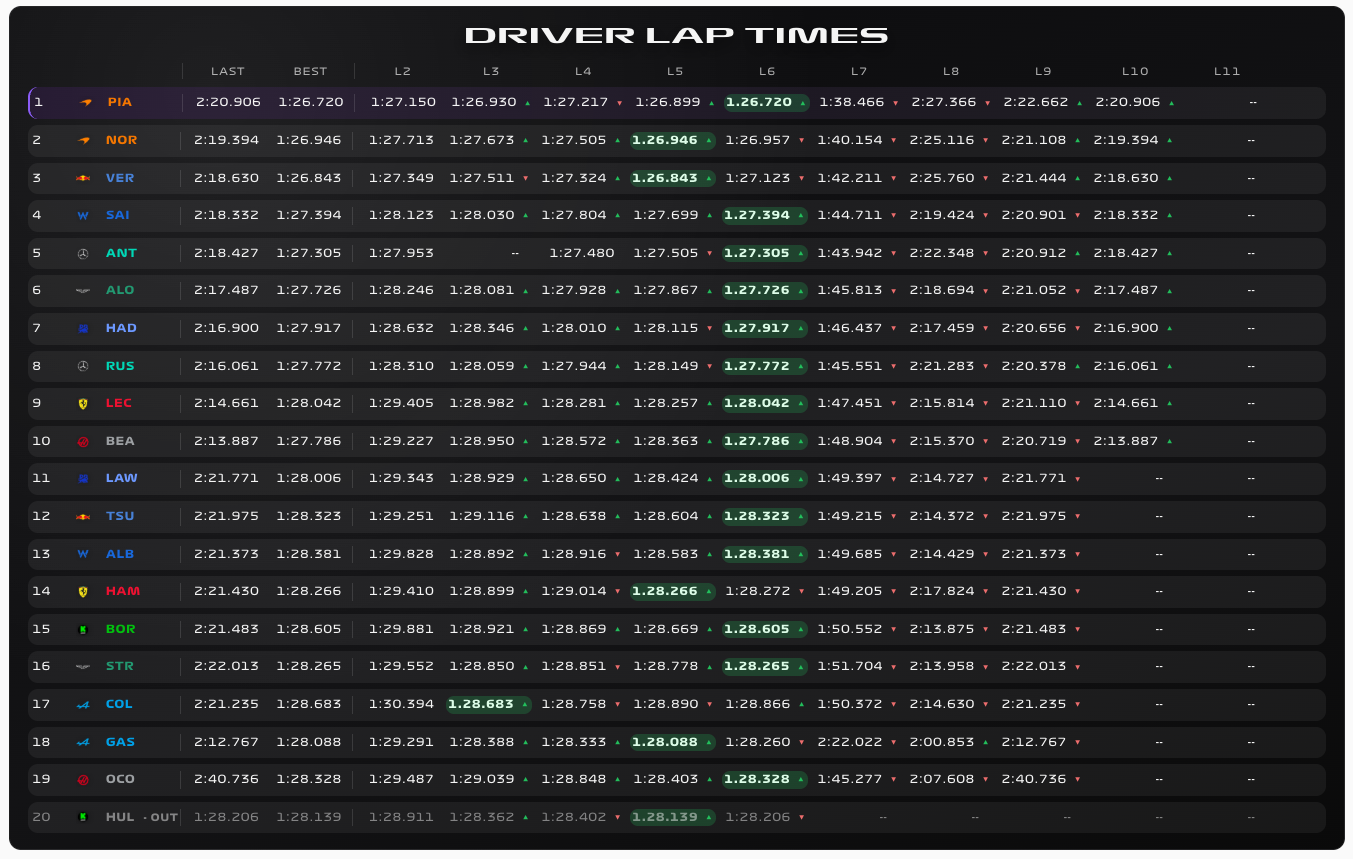
Follow positions, gaps, last laps and personal bests in a detailed timing table. Add lap-history columns when you want to compare a driver’s recent pace.
Availability
Public live / Replay. Enable Driver Positions and Driver List. Core timing uses public live data or archived replay timing. Lap-history columns depend on the laps available in the current session data.
Add the card
- Open your dashboard, select Edit dashboard, then Add card.
- Search for F1 and select the Driver Lap Times card.
- Select Driver Positions under Data Sources and confirm Driver List. Start with lap history off for a compact live table. If you enable history, set a small recent-lap limit on narrow dashboards.
- Select Save.
If the card is missing from the picker, follow Card installation. With more than one F1 Sensor entry, use the sources from the same entry; see Entity selection.
Minimal YAML
Use this in a manual dashboard card. Replace any entity ID with the one in your installation if it differs.
type: custom:f1-driver-lap-times-card
positions_entity: sensor.f1_driver_positions
theme_mode: auto
Use the card
Switch the gap reference between the car ahead and the leader using the visible toggle. Lap trends show whether times became faster or slower. Supported Weekend Hub context selections can also change the focus driver and gap reference.
Configuration
Data sources
The defaults below are the card’s fallback values. Automatic discovery connects standard sources to the selected integration entry, including renamed entity IDs. See Entity selection.
| Option | Default | Description |
|---|---|---|
drivers_entity | sensor.f1_driver_list | Driver List for names, teams and driver detail. Select the entity from your F1 Sensor entry. |
positions_entity | sensor.f1_driver_positions | Driver Positions for timing and running order. Select the entity from your F1 Sensor entry. |
no_spoiler_entity | switch.f1_no_spoiler_mode | Entity whose on state enables spoiler protection. See No Spoiler Mode. |
Display and behavior
| Option | Default | Description |
|---|---|---|
theme_mode | dark | dark, light or auto; auto follows Home Assistant. See Appearance. |
title | Driver Lap Times | Card title |
show_header | true | Show the card header |
show_table_header | true | Show column labels |
show_position | true | Show current position |
show_team_logo | true | Show team logo |
show_tla | true | Show driver TLA |
show_full_name | false | Show full driver names |
show_status | true | Show driver status |
show_gap | true | Show gap or interval |
gap_mode | ahead | ahead for the interval to the car ahead, or leader for the gap to P1. |
show_gap_toggle | true | Show the gap mode toggle |
show_last_lap | true | Show last lap time |
show_best_lap | true | Show personal best lap time |
show_lap_history | false | Show lap-by-lap history columns |
lap_history_limit | 0 | Number of recent lap columns. 0 shows all laps. |
show_lap_trend | true | Show faster/slower trend indicators |
team_logo_style | color | color or white for team logos. |
font_style | wide | wide, balanced or system. See Typography. |
All bundled cards also support f1_entry_id and card actions. Home Assistant layout settings remain available in the dashboard editor.
When data is missing
No lap history before timed laps arrive is normal. A driver can have a position without a valid completed lap. For an empty table during a session, verify both source entities are enabled and contain drivers.
For an Entity not found message, check the selection in Data Sources and confirm that the entity is enabled in F1 Sensor. For a missing card type or an old interface after an update, use the card loading checks.